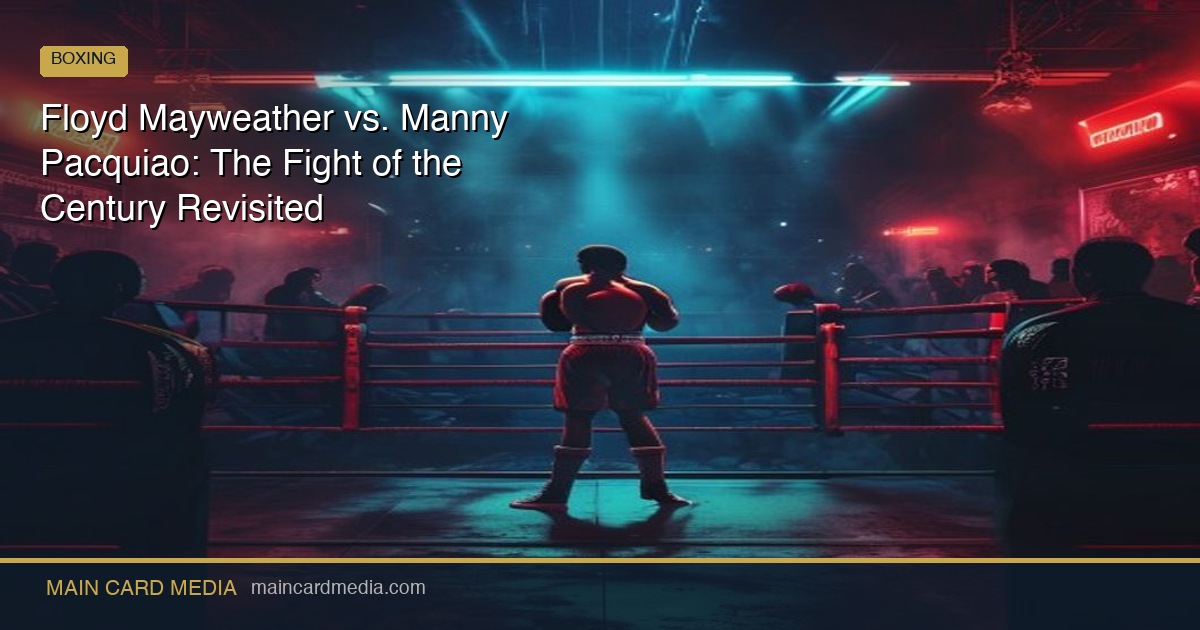
On May 2, 2015, Floyd Mayweather Jr. and Manny Pacquiao met at the MGM Grand Garden Arena in Las Vegas in the most commercially anticipated boxing match in the sport’s history. Promoted as “The Fight of the Century,” the bout generated unprecedented gate revenue, pay-per-view buys, and global attention. The result — a unanimous decision for Mayweather — was both conclusive in settling the rivalry and deeply divisive in its reception from the watching world.
The Long Road to the Fight
The Mayweather-Pacquiao fight took five years longer than it should have to materialize. Both fighters were at their peak from approximately 2009 to 2011, when the financial incentive and the competitive matchup were perfectly aligned. Negotiations broke down repeatedly over drug testing protocols, with Mayweather’s team insisting on random blood testing that Pacquiao’s team initially refused — a disagreement that kept the most anticipated fight in a generation from happening for half a decade.
By the time the fight was officially announced in February 2015, both fighters were past their prime. Mayweather was 38, Pacquiao was 36. The window of their peak rivalry had closed. But the demand was so enormous — built by years of frustrated anticipation — that the fight still generated approximately $600 million in total revenue, breaking every previous boxing record.
What Happened in the Fight
The fight itself was a masterclass in Mayweather’s defensive system and a disappointment for fans expecting a sustained firefight. Pacquiao, who had been fighting with a shoulder injury that required post-fight surgery, was unable to generate his characteristic combinations at full power. Mayweather used his right hand as a jab, slipped Pacquiao’s left hands consistently, and controlled the distance with lateral movement that made clean attacks difficult to execute.
Pacquiao had moments — combinations in rounds six, eight, and twelve that landed cleanly — but he never hurt Mayweather or changed the fight’s complexion. Mayweather was never in serious danger and landed consistently with his right hand and left hook throughout. The judges scored it 116-112, 116-112, and 118-110 in Mayweather’s favor.
The Shoulder Controversy
Pacquiao’s team revealed after the fight that he had been dealing with a shoulder injury that limited his ability to throw combinations at full extension. The revelation intensified the controversy around the result — some fans felt cheated that an injured Pacquiao had been allowed to fight, while others argued that if Pacquiao was not healthy enough to fight at full capacity, the fight should not have taken place. The Nevada State Athletic Commission investigated and found that the injury had not been properly disclosed on the pre-fight medical forms.
Was the Fight Disappointing?
The question of whether the fight was disappointing depends almost entirely on what you expected. Fans who expected a sustained war between two all-time-great knockout artists were disappointed — neither man was seriously hurt, and the fight never produced the dramatic moments that the anticipation had suggested were inevitable. The buildup had created an expectation of something genuinely historic in execution, and a competitive decision fell short of that standard.
Analysts who watched it as a skilled defensive exhibition by one of the sport’s greatest technicians found it more satisfying. Mayweather’s ability to completely neutralize Pacquiao — a fighter who had KO’d a significant portion of his opposition — is itself a remarkable competitive achievement. The argument that Mayweather is the greatest defensive boxer of his era is strengthened by a performance where he made the world’s most dynamic attacking fighter look ordinary for twelve rounds.
What the Fight Meant for Boxing
The Mayweather-Pacquiao fight’s commercial success — and the widespread sense that it failed to deliver on its potential — had complex effects on boxing. The revenue numbers proved that the sport could still generate unprecedented commercial results when the right fighters met. But the disappointment of the execution accelerated a broader sense that boxing had lost its ability to reliably deliver the dramatic moments that other combat sports — particularly MMA — more consistently provided.
The fight also functionally closed the chapter on both fighters’ careers at the highest level. Mayweather fought once more — against Andre Berto — before retiring with a perfect record. Pacquiao continued competing but never recaptured the form of his peak years. The fight was the end, not the beginning, of an era.
Legacy
The Mayweather-Pacquiao fight’s legacy is ultimately defined more by its commercial significance and its role in the sport’s history than by the actual action inside the ring. It was the richest fight in boxing’s history, the culmination of the sport’s most anticipated rivalry of the 21st century, and a commercial event that transcended sport. That its execution fell short of the drama its billing promised is a footnote to a genuinely historic commercial and cultural moment.
For historians of combat sports, the fight is significant as the final event of boxing’s traditional pay-per-view business model before streaming transformed how major events are delivered. It was the last great old-school boxing pay-per-view, and its record revenues — while eventually exceeded by UFC events in the streaming era — represent a specific moment in sports entertainment history that will not come around again in the same form.