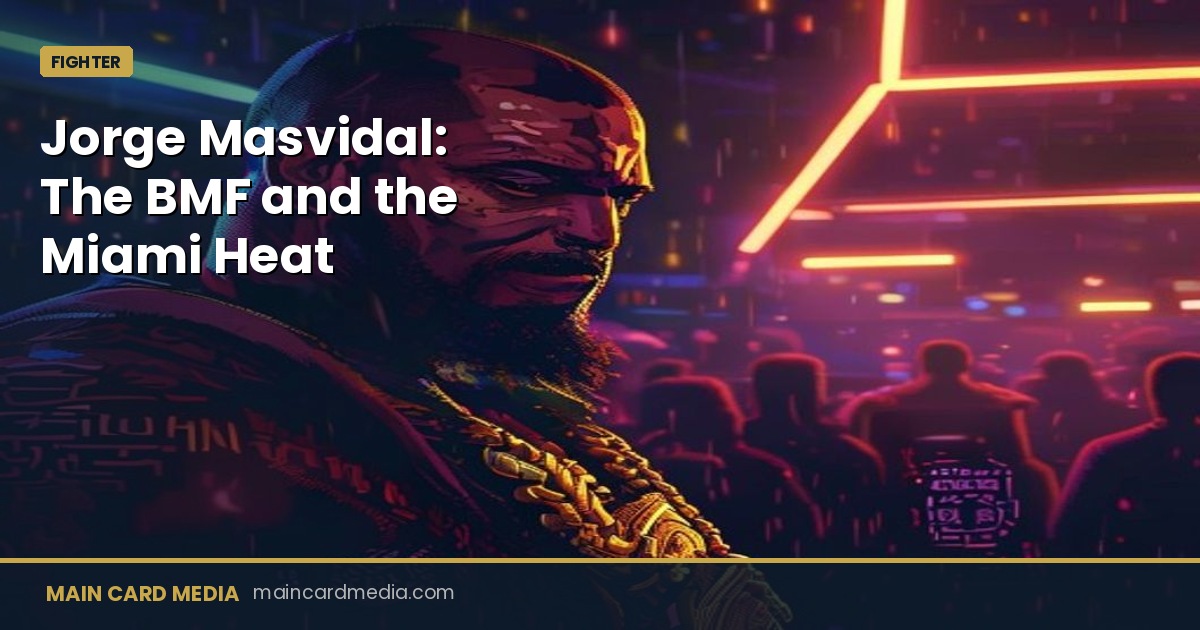
Jorge Masvidal spent fifteen years fighting in gyms and arenas nobody cared about before the UFC brass and the wider MMA world decided he was worth paying attention to. When the attention finally arrived in 2019, it arrived all at once — a five-second knockout, a belt created specifically for him, and a genuine cultural moment that neither he nor the UFC had fully planned for. This is the story of how the BMF got there.
Early Life: Miami and the Streets
Masvidal grew up in Wynwood, Miami — a neighbourhood that has since become a tourist destination for its street art and restaurants, but was considerably rougher when Masvidal came up in the 1990s. His father, Jorge Masvidal Sr., was a Cuban immigrant who spent time in prison during Masvidal’s childhood. His upbringing was unsupervised by design — no one was keeping tabs on what he was doing.
He found wrestling and fighting early, training at American Top Team in South Florida, which would later produce a generation of elite UFC fighters. His background was scrappy before it was technical — he fought because he liked fighting, not because he had a clear professional plan. The professional plan came later, when the street fighter found out he was actually good enough to make money at this.
The Long Road: 2003–2017
Masvidal turned professional in 2003 at 18 years old. The early years of his career were a circuit of regional promotions, street fights broadcast on YouTube channels, and the kind of obscurity that defines the lower tiers of professional MMA. He fought in Strikeforce, Bellator, and World Series of Fighting before landing a UFC contract in 2013.
His UFC career started well enough — wins, losses, competitive performances against good opposition — but nothing that separated him from the dozens of other 170-pound fighters working their way through the contender pool. He was a street brawler who had learned technique, a solid UFC welterweight who would probably land somewhere in the top fifteen if things went right and never higher.
That was the assessment until 2019. Then everything changed.
The Gamebred Explosion: 2019
Three fights in 2019 turned Masvidal from a solid UFC veteran into one of the sport’s biggest names. The sequence started with a decision win over Darren Till in London — an upset that announced him as a genuine top-five welterweight. Then came the knockout of Ben Askren.
Five seconds. Masvidal threw a flying knee the moment the referee said “fight,” caught Askren flush on the jaw as he shot for a takedown, and Askren hit the canvas unconscious before most people in the arena had registered what happened. It is still the fastest finish in UFC history, and it landed on an opponent who had been positioned as the uncrackable grappling machine — the hardest man to finish in MMA. Masvidal cracked him in five seconds.
The internet responded the way 2019 internet responded to things: instantly and completely. The clip went viral outside the MMA ecosystem. Non-fans knew who Jorge Masvidal was by the end of that week. The UFC saw what was happening and moved fast.
The BMF Belt
UFC President Dana White created the “BMF” — Baddest Motherf***er — title belt specifically for the fight between Masvidal and Nate Diaz at UFC 244 in November 2019. It was part marketing exercise, part genuine recognition that these two fighters occupied a cultural space in the sport that didn’t fit neatly into divisional rankings and title shots.
Diaz is the other fighter in recent memory who has had a similar effect on non-combat sports audiences — raw, unfiltered, and completely disinterested in conventional sports marketing. Putting Masvidal and Diaz in a cage and calling the winner the BMF was the UFC doing something it rarely does: leaning into the culture the fighters were creating rather than trying to manage it.
Masvidal won by doctor stoppage in the fourth round — Diaz had a bad cut above his eye that the ringside physician stopped the fight over. Masvidal received the BMF belt. The narrative was complete. He had gone from regional circuit veteran to the holder of the sport’s most theatrical title in one year.
Title Shots and the Kamaru Usman Fights
The BMF belt created the argument for a welterweight title shot. Masvidal fought Kamaru Usman for the UFC welterweight title twice — first at UFC 251 on six days’ notice when Gilbert Burns pulled out with COVID-19, and again at UFC 261 in a rematch.
Both fights went to Usman. The first was a competitive decision where Masvidal came in without a full camp and gave a credible account of himself. The second was a second-round KO — Usman caught him clean, Masvidal went out, and the rematch gave a clearer answer than the first fight had.
The losses didn’t erase what 2019 had built. They confirmed that Masvidal’s ceiling in the divisional hierarchy was genuine top-five but short of champion. That’s a legitimate legacy for a fighter who spent a decade not being considered for that conversation at all.
The Last Stretch and What Comes Next
Masvidal’s career post-Usman fights wound down without another major result. The 2019 version of Gamebred — the explosive street fighter who had figured out how to weaponise every chaotic instinct he had — aged into a fighter who remained dangerous but couldn’t recreate the sequence of performances that had made him a star.
That happens. Elite athletes have windows and Masvidal’s came late — a fighter who had been a journeyman welterweight until he was 34 and then became one of the biggest names in the sport for eighteen months. The BMF belt sits in a trophy case somewhere in Miami. The five-second knockout exists on the internet forever.
Legacy
Masvidal isn’t a UFC champion. He never held an undisputed title, never defended a belt, never ran off a title-reign-length streak of wins. His legacy is something different and arguably more durable in the sport’s popular culture: he’s the fighter who embodied the street fighter fantasy at a moment when that story connected globally, and he made it feel true in the most unlikely possible year of his career.
The BMF title exists because of Jorge Masvidal. No other fighter in the sport’s history could have occupied that specific moment the same way. That’s enough for a legacy that the won-loss record alone can’t capture.



Leave a Reply