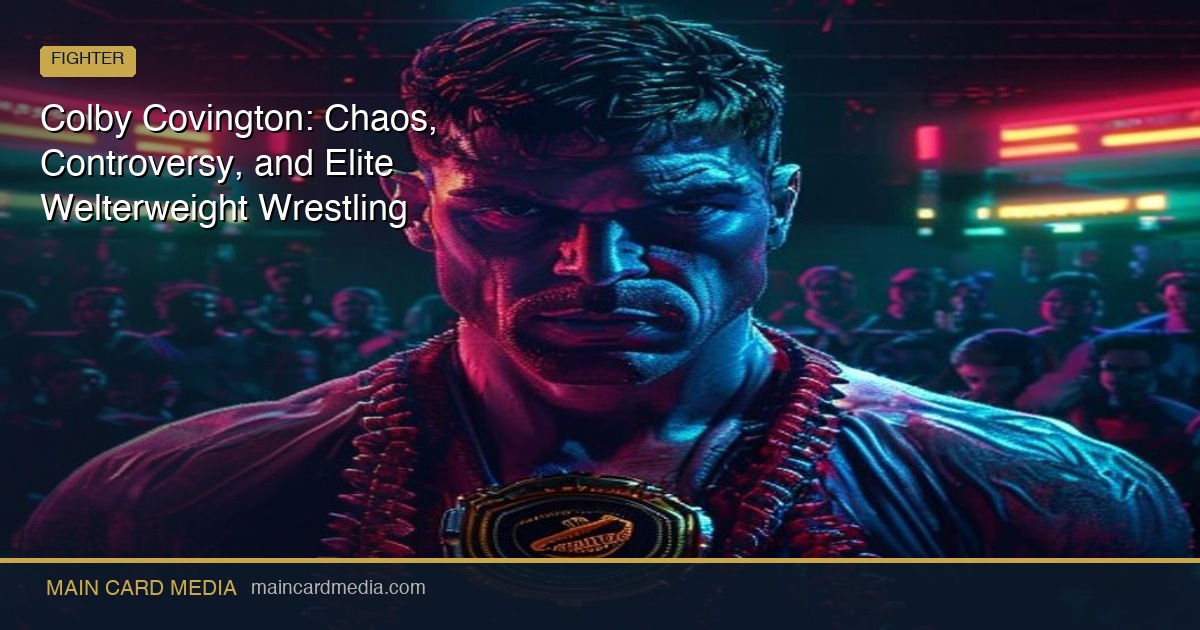
Colby Covington is one of the most polarizing figures in UFC history — a fighter who built a deliberately antagonistic public persona to generate attention, then backed it up with wrestling-based performances that place him among the most effective welterweights of his era. Whether you love or hate “Chaos,” his impact on the division and the sport is undeniable.
Background and Wrestling Credentials
Colby Covington was born on February 22, 1988, in Clovis, California. He was a standout wrestler at Oregon State University, becoming a two-time All-American and earning a reputation as one of the best collegiate wrestlers in the country. That wrestling foundation would become the cornerstone of his MMA career.
He joined the UFC in 2014 and spent his early years as a solid but unspectacular competitor. His wrestling was elite, but he lacked the personality or marketing that attracted attention. That changed in 2017 when he began adopting the “Chaos” persona — making inflammatory political statements, trash-talking opponents in graphic terms, and positioning himself as a villain who would sell fights.
The Persona That Built a Career
Whether Covington’s political posturing and trash talk are genuine or calculated marketing is a question only he can answer definitively. What’s clear is that it worked. His callouts and inflammatory statements generated enormous media attention, turning him from an anonymous fighter into must-follow social media content and must-watch TV.
His win over former champion Demian Maia via unanimous decision in August 2017 — followed by a post-fight trash talk rant that set Brazilian social media on fire — established the template. The attention generated by his mouth ensured his next fights would be taken seriously by the UFC matchmakers.
Interim Title and Usman Fights
Covington won the interim UFC Welterweight Championship in June 2018, defeating Rafael dos Anjos by unanimous decision in a dominant wrestling showcase. The interim title set up his eventual unification fight against champion Kamaru Usman at UFC 245 in December 2019.
The Usman fight was an elite-level welterweight clash. Both men were Division I All-American wrestlers choosing to fight in the pocket, and the result was a competitive, tactical war. Usman stopped Covington in the fifth round with a right hand and follow-up strikes, but Covington had proven himself as one of the top two welterweights in the world.
Their rematch at UFC 268 in November 2021 was even closer — five rounds of strategic chess that Usman won by split decision. Many observers felt Covington had done enough to win the fight, making the result one of the more disputed in recent memory.
The Jorge Masvidal Rivalry
Covington’s rivalry with Jorge Masvidal added genuine personal animosity to the combat sports theatrical tradition. The two were former training partners and close friends whose relationship deteriorated into a bitter public feud. Their first fight at UFC 272 in March 2022 was eagerly anticipated as genuine hatred inside the cage.
Covington won a clear unanimous decision, using his wrestling and pace to outwork Masvidal over five rounds. The rematch didn’t happen — Masvidal’s career took different directions — but the first fight demonstrated that Covington’s abilities extended beyond performance; he could deliver in the biggest moments.
Defeating Tyron Woodley: Twice
Covington defeated former champion Tyron Woodley at UFC Fight Night in September 2020, stopping him in the fifth round after four rounds of wrestling-heavy dominance. The stoppage was brutal — Covington landing a right hand that buckled Woodley before following with ground strikes.
The wins over Woodley, Masvidal, dos Anjos, and Robbie Lawler represent a resume of credible victories against former champions and elite competition that validates Covington’s standing among the welterweight elite regardless of his persona.
Fighting Style: Volume Wrestling
Covington’s game is built on a relentless pace that few fighters can match. He takes enormous numbers of shots in training to develop his cardio, entering fights with the ability to maintain high output across 25 minutes without fading. His wrestling creates constant threat, forcing opponents to either engage in a takedown battle or face a wrestling-enhanced striking game.
He’s not a knockout artist — most of his wins come by decision or late stoppage when opponents are exhausted. His game is about accumulation: more strikes, more takedowns, more cage pressure, more activity. It’s an approach that’s boring to some observers but brutally effective against elite competition.
Legacy
Colby Covington’s legacy will be debated based on the lens through which observers view him. To detractors, he’s a fighter who manufactured a persona to get opportunities his abilities alone might not have generated. To supporters, he’s a fighter who understood that MMA is entertainment as well as sport and played the game brilliantly.
What’s inarguable is his place in the welterweight hierarchy. Two title fights against one of the division’s greatest champions, wins over multiple former champions, and the ability to compete at the highest level for nearly a decade — the fighting record speaks for itself regardless of the noise around it.